
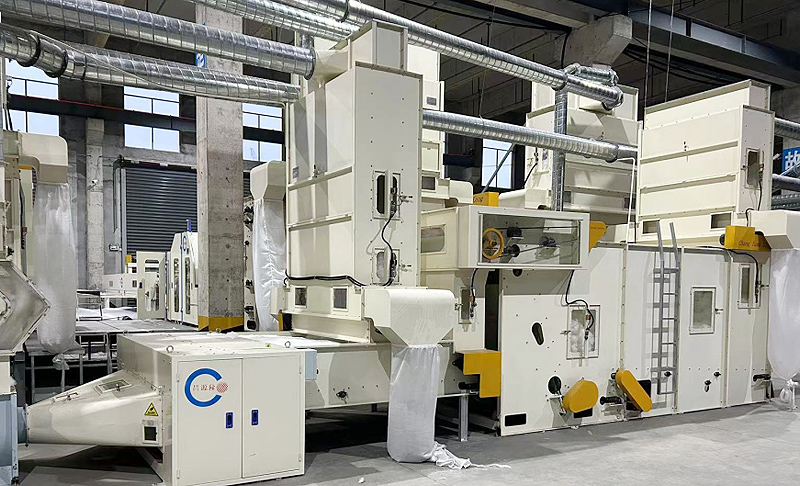
| CABINET BLENDING HOPPER | ||||
| TYPE | SPECIFICATION | NOTE | ||
| CYLMS-2300 | working width | 2300mm | blender with vibrating | |
| power | 8~20m³ | |||
| output | 3.75kw | |||
| roll diameter | 350mm | |||
What is it and what does it do?
Imagine you’re making a smoothie. You don’t just throw in all your ingredients at once, right? You measure them out and often blend them in stages to get the perfect taste and consistency. A blending hopper is like the “measuring and pre-mixing” stage for making non-woven fabrics.
Its main job is to take different types of fibers (or the same fiber but in different forms) and mix them together in precise proportions to create a uniform blend.1 This is super important because the blend of fibers determines the final properties of the non-woven fabric, like its strength, softness, absorbency, etc.
How is it done?
Blending hoppers use a combination of mechanisms:
- Multiple Inputs: They have multiple feeding points or openings where different fibers can be loaded. Each input usually has its own feeding system (like a conveyor belt or a metering device) to control the amount of fiber entering the hopper.
- Weighing/Metering: Often, there are weighing systems or volumetric metering devices associated with each input. This ensures that the correct amount of each type of fiber is added to the mix, maintaining the desired blend ratio.
- Mixing: Inside the hopper, there are rotating paddles, augers, or other mixing mechanisms that thoroughly combine the fibers. This creates a homogeneous blend, ensuring that the fibers are evenly distributed.
- Output: The blended fibers are then discharged from the hopper, usually onto a conveyor belt or into another processing machine, ready for the next stage in the non-woven production line.
Use in the Non-Woven Sector
Blending hoppers are crucial in non-woven manufacturing for several reasons:
- Fiber Variety: Non-woven fabrics often use a mix of different fibers (e.g., cotton, polyester, rayon, etc.) to achieve specific properties. The blending hopper allows manufacturers to combine these fibers in precise ratios.
- Uniformity: It ensures that the fibers are evenly distributed throughout the blend, leading to consistent quality and performance in the final non-woven product.
- Customization: By adjusting the proportions of different fibers in the blend, manufacturers can tailor the properties of the non-woven fabric to meet specific application requirements. For example, a blend for diapers will be different from a blend for medical wipes.
- Cost Optimization: Blending allows manufacturers to use a mix of different fibers, potentially including less expensive options, while still achieving the desired performance characteristics.
Think of it this way:
Imagine you’re baking a cake. The recipe calls for specific amounts of flour, sugar, butter, and eggs. You carefully measure each ingredient and then mix them thoroughly to create the batter. The blending hopper is like the “measuring and mixing bowl” in the non-woven manufacturing process.
In short, the blending hopper is a vital piece of equipment that allows non-woven manufacturers to create customized fiber blends with precise control over the final product’s properties. It’s all about getting the perfect “recipe” of fibers for the specific non-woven material being produced.