
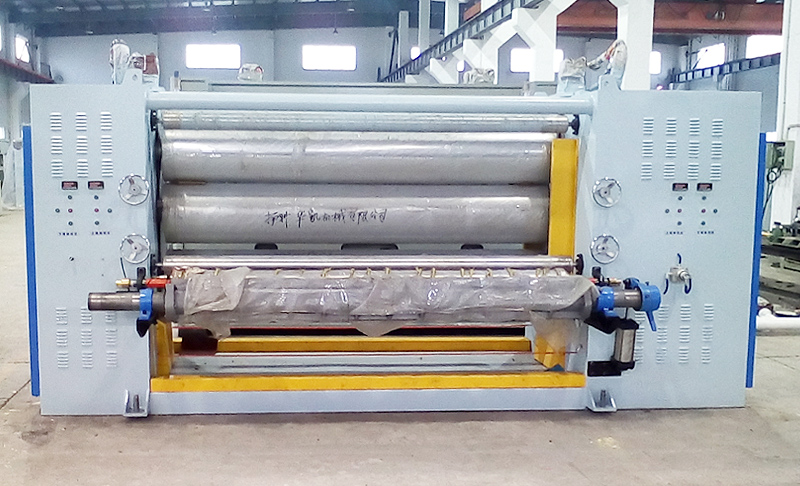
| CALENDERING MACHINE | |||
| TYPE | SPECIFICATION | NOTE | |
| YBG321 | working width | 4800mm | oil heating |
| speed | 1~10m/min | ||
| power | 80kw | ||
What is a Calendering Machine and What Does It Do?
Imagine you have a piece of fabric that’s a bit rough or uneven. You might iron it to make it smoother and give it a more finished look. A calendering machine does something similar to non-woven fabrics.
Its main job is to take a non-woven fabric and pass it between heated rollers to smooth it, flatten it, and/or impart a specific texture or finish.1 It’s like the “ironing and finishing” stage for non-wovens.
How Does the Calendering Machine Work?
Calendering machines use a combination of heated rollers and pressure to achieve this:2
- Infeed: The non-woven fabric is fed into the calendering machine, usually coming from a previous process like needle punching or bonding.3
- Heated Rollers: The fabric passes between two or more rollers that are heated to a specific temperature.4 The heat softens the fibers slightly, making them more pliable.
- Pressure: The rollers apply pressure to the fabric, smoothing it, flattening it, and reducing its thickness.5 The amount of pressure determines the degree of smoothing and flattening.
- Surface Texture (Optional): Some calendering rollers have special surface patterns (e.g., embossed designs) that can be transferred to the fabric, creating a desired texture or appearance.6
- Cooling (Optional): After passing through the heated rollers, the fabric may pass over cooling rollers to set the finish.
- Output: The finished non-woven fabric is then delivered out of the machine, ready for further processing or use.
Calendering Machine Applications in the Non-Woven Sector
Calendering machines are used in non-woven manufacturing when you need:
- Smoothness and Uniformity: They create a smoother, more uniform surface on the non-woven fabric, improving its appearance and feel.7
- Controlled Thickness: They can reduce the thickness of the fabric to meet specific requirements.8
- Surface Texture: They can impart a desired texture or pattern to the fabric, enhancing its aesthetic appeal or functionality.9
- Improved Properties: Calendering can sometimes improve certain fabric properties, such as its strength, stiffness, or drape.10
Think of it this way:
Imagine rolling out a piece of clay with a rolling pin. You can control how smooth and flat the clay becomes by adjusting the pressure. The calendering machine is like a very precise, heated “rolling pin” for non-woven fabrics.
In short, the calendering machine is a finishing step that refines the surface and properties of non-woven fabrics by smoothing, flattening, and texturing them.11 It’s a key process fKey Benefits of Using a Calendering Machine
Manufacturers choose calendering machines for their non-woven production because they offer numerous advantages. The calendering machine improves product quality, consistency, and marketability. With adjustable temperature and pressure settings, the calendering machine allows manufacturers to fine-tune their fabric properties to meet specific customer requirements. The versatility of the calendering machine makes it an essential piece of equipment in modern non-woven manufacturing facilities.
Why Calendering Machines Matter
In the competitive non-woven industry, the calendering machine delivers results that directly impact product value and performance. Whether producing hygiene products, filtration materials, or geotextiles, the calendering machine ensures that fabrics meet stringent quality standards. By investing in a high-quality calendering machine, manufacturers gain a significant competitive advantage in their market.or achieving the desired look, feel, and performance characteristics in the final non-woven product.The calendering machine represents a critical investment for manufacturers serious about product quality and market competitiveness. As the non-woven industry continues to evolve with increasing demands for superior fabric properties, the calendering machine remains indispensable for meeting these requirements.This essential process technology is fundamental to the industry.