
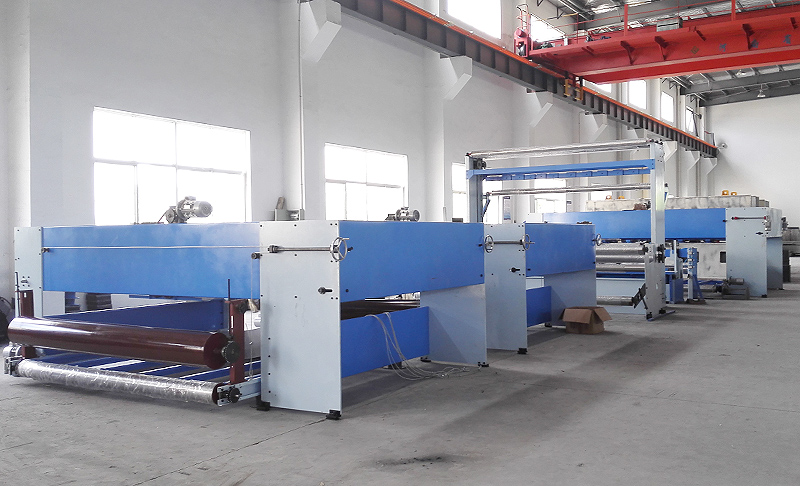
| CLAMPING LAPPER | ||||
| TYPE | SPECIFICATION | NOTE | ||
| YBG101 | input width | 2000~3000mm | PLC / VFD | |
| output width | 2600~7200mm | |||
| speed | 10~50m/min | |||
| power | 5kw | |||
What is it and what does it do?
Imagine you’re making a layered pastry, like a croissant. You need to repeatedly fold and layer the dough to create those delicate, flaky layers. A clamping lapper does something similar with a web of fibers in non-woven manufacturing.
Its main job is to take a continuous web of fibers (usually from a carding machine) and fold it back and forth in a very specific way to create a thicker, layered web. This layered web is then used in the next steps of the non-woven process.
How is it done?
Clamping lappers use a combination of belts, rollers, and a “clamping” mechanism to achieve this folding:
- Infeed: The web of fibers is fed into the clamping lapper.
- Clamping: The “clamping” part involves two belts or surfaces that come together, “clamping” the web and holding it in place.
- Folding & Layering: Other belts or rollers then move and fold the web back and forth, creating a series of layers. The way these belts move determines how the web is folded (e.g., into a “z” shape or other patterns).
- Delivery: The layered web is delivered out of the machine, ready for the next step in the non-woven process.
Use in the Non-Woven Sector
Clamping lappers are used in non-woven manufacturing when you need:
- Specific Web Structure: They create a layered web with a particular fold pattern, which can affect the final properties of the non-woven fabric (like its strength and how it drapes).
- Thickening the Web: By repeatedly folding the web, they increase its thickness and weight.
- Preparing for Bonding: The layered web created by a clamping lapper is often an intermediate step before the non-woven material is bonded together using techniques like needle punching, thermal bonding, or chemical bonding.
Think of it this way:
Imagine folding a piece of paper like a fan. Each fold creates a layer, and the more folds you make, the thicker the fan becomes. A clamping lapper does something similar with the fiber web, folding it in a precise and automated way.
In short, the clamping lapper is a specialized machine for creating layered fiber webs with specific fold patterns. It’s a key part of producing certain types of non-woven materials, especially those requiring a particular structure or thickness.
Key Benefits and Advantages of Clamping Lapper Machines
A clamping lapper offers numerous advantages in non-woven textile production. The primary benefit is the ability to achieve uniform, consistent layering of fiber webs, which directly impacts the quality and durability of the final product.
Clamping Lapper Applications and Industries
Clamping lappers are essential in several key industries. In the automotive sector, they produce materials used for sound dampening and thermal insulation. In construction, clamping lapper machines help create reinforced non-woven fabrics for roofing underlayment and wall insulation.
The hygiene products industry also relies heavily on clamping lappers for producing components used in diapers, sanitary napkins, and other personal care items. The medical industry uses these machines to create specialized non-woven fabrics for surgical drapes, wound dressings, and filtration applications.
Clamping Lapper Technical Specifications and Capacity
The YBG101 clamping lapper model represents a modern solution for production. With input width ranging from 2000 to 3000 millimeters and output width capability of 2600 to 7200 millimeters, this machine offers exceptional flexibility. The power requirement of 5 kilowatts makes it relatively energy-efficient.
Clamping Lapper: Conclusion
The clamping lapper remains an indispensable piece of equipment in non-woven textile manufacturing. Whether for automotive, medical, or industrial applications, these machines provide the reliability and precision needed to produce high-quality non-woven materials.