
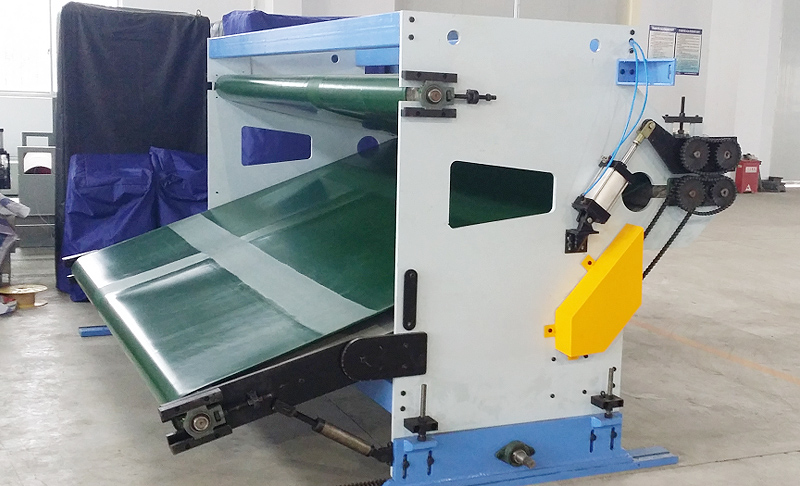
| THE FEEDER | ||||
| TYPE | SPECIFICATION | NOTE | ||
| YBG301-480 | working width | 4400mm | available for the heavy weight material | |
| speed | 0.5^6m/min | |||
| power | 1.5kw | |||
What is it and what does it do?
The fiber feeder is a critical equipment in non-woven fabric production.Imagine you have a big pile of cotton (or other fibers) that needs to be moved steadily and consistently into a machine like a carding machine or a blending hopper. A feeder is like a “metering and delivery” system for these fibers.
Its main job is to take a mass of loose fibers and deliver them at a controlled rate and in a consistent form to the next machine in the production line. This ensures that the downstream machines receive a steady and even flow of material, which is essential for consistent product quality.
How is it done?
Feeders come in various designs, but they generally use a combination of these mechanisms:
- Input: The fibers are loaded into the feeder, either manually or via a conveyor system. This input could be in the form of a loose mass, a lap (a sheet of loosely matted fibers), or even bales in some cases.
- Metering: The feeder uses a system of belts, rollers, or spiked lattices to control the amount of fiber being delivered. These mechanisms regulate the flow rate, ensuring a consistent and measured amount of material is fed forward.
- Delivery: The fibers are then delivered out of the feeder, usually in a more uniform and manageable form. This might be a continuous web, a sliver (a strand of loosely aligned fibers), or a metered flow of loose fibers.
Use in the Non-Woven Sector
Feeders are essential in non-woven manufacturing for several reasons:
- Consistent Material Flow: They ensure a steady and even supply of fibers to the carding machines, blending hoppers, and other processing equipment. This is crucial for maintaining consistent product quality.
- Precise Metering: They allow for precise control over the amount of fiber being processed, which is important for achieving desired fabric weight and thickness.
- Automated Production: They enable automated and continuous operation of the non-woven production line, improving efficiency and reducing labor costs.
- Buffering: They can act as a buffer, storing a certain amount of fiber material and releasing it at a controlled rate, which helps to smooth out variations in the incoming material flow.
Think of it this way:
Imagine you’re filling bottles with juice on an assembly line. You need a system to ensure that each bottle gets the same amount of juice. The feeder is like the “juice dispenser” in the non-woven manufacturing process, making sure that each machine gets the right amount of fiber at the right rate.
In short, the feeder is a crucial link in the non-woven production line, ensuring a consistent and controlled flow of fibers to the various processing machines.1 It’s all about maintaining a smooth and efficient production process and ensuring consistent product quality.
Conclusion: Fiber Feeder Technology and Its Impact on Non-Woven Manufacturing
The advancement of fiber feeder technology has revolutionized the non-woven industry. Modern fiber feeder machines come equipped with sophisticated controls and automation features that allow manufacturers to achieve unprecedented levels of precision and consistency. Whether it’s a simple gravity-fed system or a complex electronically controlled unit, the fiber feeder remains indispensable in producing quality non-woven fabrics.
Investing in a high-quality fiber feeder system can significantly enhance production efficiency, reduce waste, and improve product quality. As industries continue to evolve and demand more specialized fabrics, the role of advanced fiber feeder equipment becomes even more critical in meeting these challenges.