
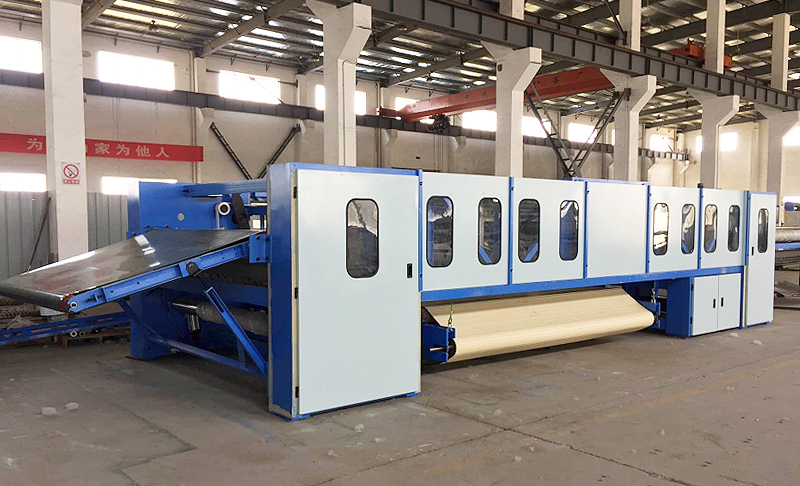
| HIGH SPEED LAPPER | ||||
| TYPE | SPECIFICATION | NOTE | ||
| YBG104 | input width | 2000~3000mm | PLC / VFD | |
| output width | 2600~8000mm | |||
| speed | 10~80m/min | |||
| power | 7.5KW | |||
What is it and what does it do?
Imagine you’re quickly layering sheets of fabric to build up thickness for a blanket. A high-speed lapper does something similar with a web of fibers, but at a much faster pace.
Its main job is to take a continuous web of fibers and fold it back and forth rapidly, creating a thick, layered web. This is a crucial step in building up the necessary thickness and weight for many non-woven materials. The “high-speed” part means it does this layering much faster than other types of lappers.
How is it done?
High-speed lappers utilize a combination of belts, rollers, and a specialized folding mechanism to achieve rapid layering:
- Infeed: The web of fibers is fed into the lapper, usually coming directly from a carding machine or another preceding process.
- High-Speed Folding: The key feature is a mechanism that folds the web back and forth at very high speeds. This might involve rapidly moving belts, oscillating guides, or other specialized designs. The goal is to create consistent, even folds despite the fast speed.
- Layering: These high-speed folds are laid down onto a moving conveyor belt, building up the thickness and width of the web.
- Delivery: The resulting layered web is delivered out of the machine, ready for the next stage in the non-woven process.
Use in the Non-Woven Sector
High-speed lappers are essential in non-woven manufacturing when:
- High Productivity is Required: They’re used when manufacturers need to produce large volumes of non-woven material quickly.
- Specific Web Structure is Needed: Like other lappers, they create a layered web with a particular fold pattern, influencing the final non-woven properties.
- Preparing for Bonding: The layered web is typically further processed by bonding techniques like needle punching or thermal bonding to create the final non-woven product.
Think of it this way:
Imagine a machine that can fold a piece of cloth into pleats incredibly fast. A high-speed lapper is similar; it rapidly folds the fiber web to create multiple layers.
In short, the high-speed lapper is a workhorse in the non-woven industry, quickly building up the thickness of fiber webs. It’s all about efficient and rapid layering to meet production demands for various non-woven applications.
Key Features of High-Speed Lappers
Modern high-speed lappers come equipped with several advanced features that enhance their performance and efficiency. The precision control systems allow operators to adjust folding speeds and layering patterns to meet specific material requirements. Automated feeding mechanisms ensure consistent fiber distribution, while sensors monitor the quality of the layered web in real-time.
High-speed lappers are designed to be versatile and can process a wide range of fiber materials, including polyester, polypropylene, glass fibers, and blended compositions. This versatility makes them invaluable in producing diverse non-woven products such as geotextiles, filtration media, insulation materials, and hygiene products.
Advantages of High-Speed Lapper Technology
The implementation of high-speed lappers in non-woven manufacturing offers numerous benefits. First, they significantly increase production throughput, allowing manufacturers to meet growing market demand efficiently. Second, the consistent layering ensures uniform product quality, reducing defect rates and waste. Third, the energy-efficient design of modern high-speed lappers helps reduce operational costs while minimizing environmental impact.
Additionally, high-speed lappers enable manufacturers to create complex web structures with specific directional properties. This capability is crucial for applications requiring specialized performance characteristics, such as thermal bonding or improved tear resistance.
Choosing the Right High-Speed Lapper
When selecting a high-speed lapper for your non-woven manufacturing facility, consider factors such as your production volume requirements, fiber materials, desired web properties, and budget constraints. The specifications should align with your current production capacity and future expansion plans. Working with experienced manufacturers like OpenWay China ensures you get equipment optimized for your specific needs.