Socks Pressing Machine
Sock Boarding and Setting machines
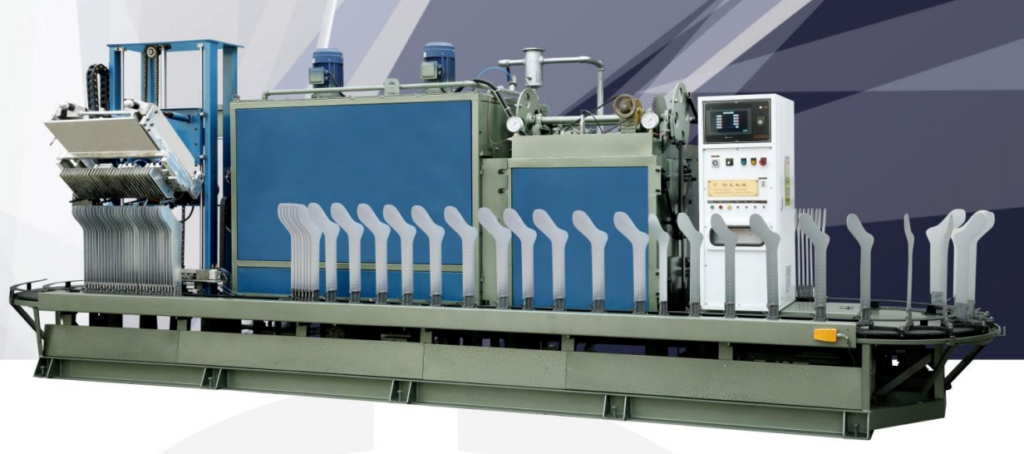
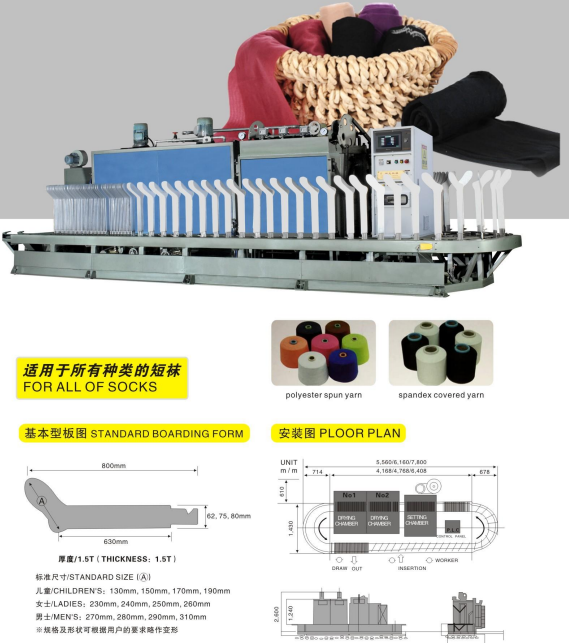
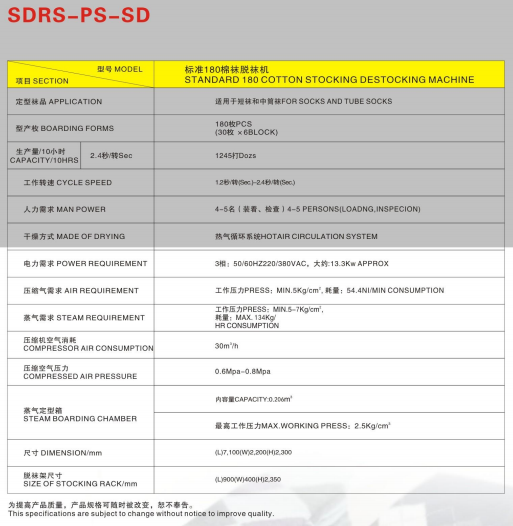
we offers a complete range of SDRS sock boarding and setting machines designed for all kinds of socks, stockings and pantyhose, from children’s to men’s long hose, with capacities from 45 dozen per hour on compact 9‑pin electrical models to over 3,000 dozen per 10 hours on high‑output steam boarding lines. These fully automatic machines use hot‑air circulation and bidirectional steam‑setting technology to deliver uniform shaping, smooth surface finish and stable dimensions while significantly reducing shrinkage, labour and energy costs. Key features include multiple boarding forms (180–350 pins per cycle with 6–8 blocks), adjustable cycle speeds from about 0.8–2.4 pairs per second, PLC/computer control, and flexible foot‑frame sizes so the same line can handle different product styles and sizes with quick changeovers. The SDRS‑P.S, SDRS‑P.BD and SDRS‑PS‑SD series provide options for standard cotton socks, tube socks and high‑class products, with steam chambers engineered for stable pressure, efficient heat transfer and low air/steam consumption, ensuring consistent quality even at maximum loading. Rugged construction, user‑friendly controls and optimized floor‑plan layouts make these sock boarding machines ideal for hosiery manufacturers who want higher productivity, better shape retention and a professional, retail‑ready finish on every pair.
supplies a complete range of SDRS series sock boarding and setting machines engineered to give hosiery manufacturers high productivity, consistent shaping and a premium retail finish for all kinds of socks, stockings and pantyhose. Designed around proven Korean SDRS technology, these automatic rotary steam and electrical setting machines combine robust construction with intelligent controls, allowing you to finish children’s, ladies’ and men’s socks on a single line with minimal labour and energy consumption.
SDRS Socks Pressing Machine Product Range Overview
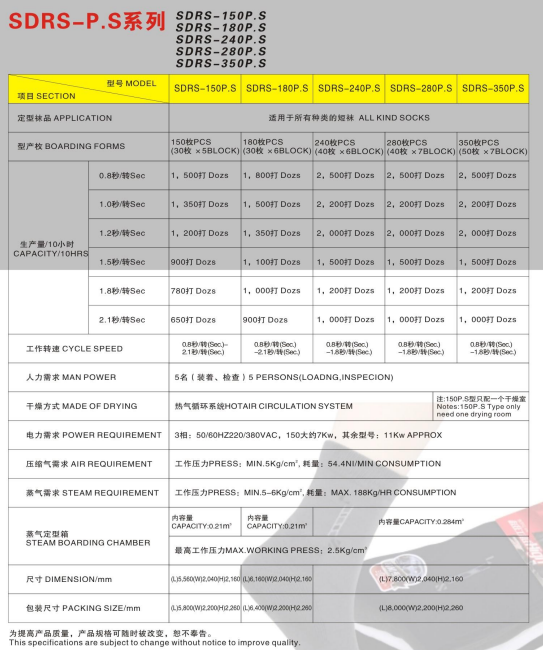
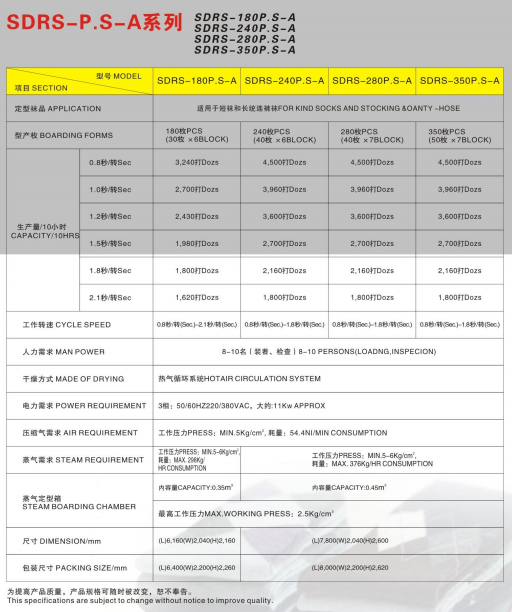
- SDRS‑P.S series auto rotary steam setting machines are designed for all kinds of socks and are available in 150P.S, 180P.S, 240P.S, 280P.S and 350P.S models to match different production scales.
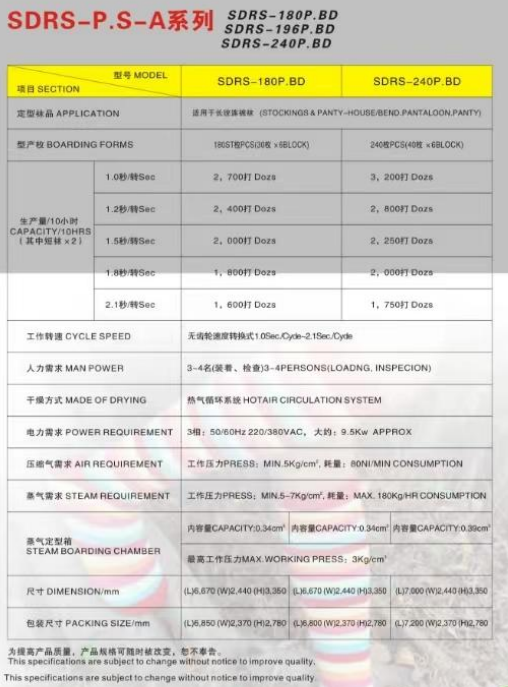
- SDRS‑P.S‑A series machines (such as SDRS‑180P.S‑A and SDRS‑240P.S‑A) provide enhanced automation and higher capacities, ideal for large volume exporters who need stable output on multiple shifts.
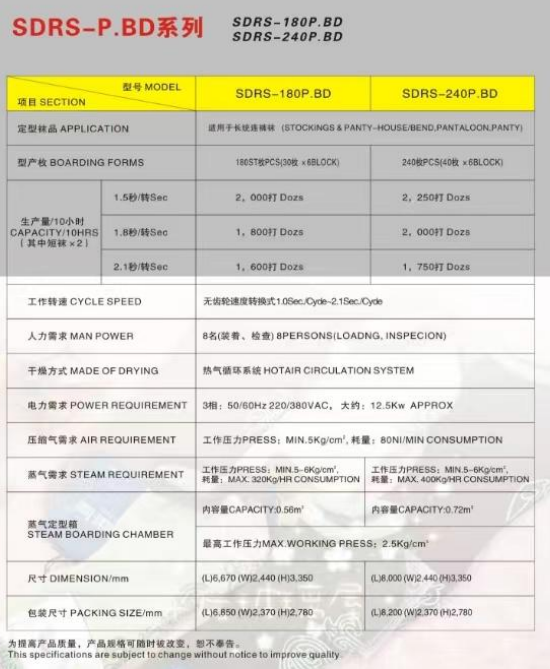
- SDRS‑P.BD and SDRS‑P.BD‑A models are optimised for stockings, pantyhose and long hose, with extended boarding forms and bidirectional steam circulation to ensure even setting over the entire leg length.
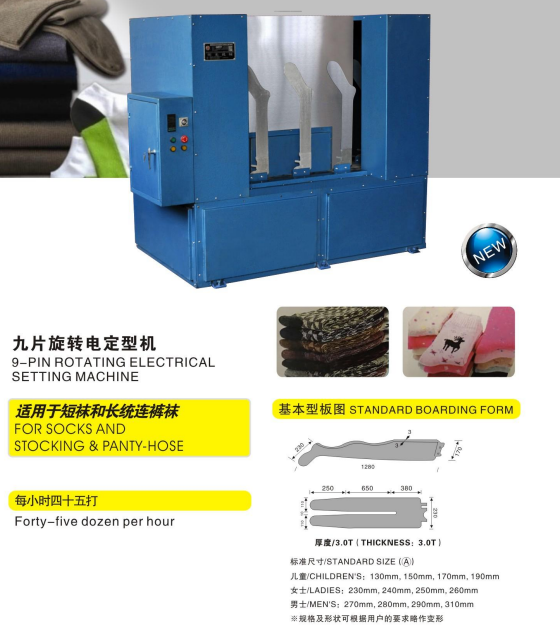
- Compact 9‑pin rotating electrical setting machines are available for smaller factories and sampling rooms, offering approximately 45 dozen pairs per hour on a simple, low‑power electrical platform.
Capacity, boarding forms and cycle speed
- Standard rotary steam models offer 180 to 350 boarding forms per cycle, typically arranged as 30–50 pieces × 6–8 blocks, allowing continuous loading, steaming and unloading on a moving carousel.
- Depending on the model and selected cycle speed, capacities range from around 1,200–1,500 dozen per 10 hours on smaller units up to about 3,000–3,300 dozen per 10 hours on larger SDRS‑240 and SDRS‑280 machines.
- Cycle speeds are adjustable, commonly from about 0.8 to 2.4 forms per second, so operators can fine‑tune the balance between production volume and setting quality according to yarn type and fabric thickness.
- In practice a single SDRS rotary machine can support the output of multiple circular knitting machines, making it the central finishing stage in a modern sock production line.
Socks Pressing Machine: Heating, Drying and Steam System
- All major SDRS boarding lines use a hot‑air circulation drying system combined with saturated steam in a closed chamber, ensuring fast heat transfer and uniform temperature on every frame.
- Bidirectional steam setting improves penetration into the fabric, reduces residual shrinkage and enhances dimensional stability, giving socks a smooth, wrinkle‑free surface and long‑lasting shape.
- Typical power requirements for full‑size steam rotary machines are three‑phase 220/380 V, 50/60 Hz, with installed power in the range of roughly 9–13 kW depending on model and chamber size.
- Steam pressure is usually regulated around 5–6 kg/cm² with carefully controlled consumption, while compressed air (often 0.6–0.8 MPa) is used for actuators, automatic doors and safety systems to maintain stable operation.
Electrical sock setting and 9‑pin machine
- The compact 9‑pin rotating electrical setting machine uses electric heating elements inside metal foot boards, powered by single‑phase 220 V, 50 Hz, making it easy to install in smaller workshops without a boiler.
- Temperature on the iron forms is adjustable, and heat distribution is uniform across the board surface, which is essential for synthetic yarns, rubber threads and spandex that require precise thermal treatment to stabilise elasticity.
- After a short preheating period of roughly 10–15 minutes, the machine can run continuously, with each form typically requiring only 8–10 seconds of heating once the sock is mounted, enabling around 200–300 pairs per hour per operator.
- Because multiple shapes of sock forms can be fitted on the same base, the electrical machine is highly flexible for sampling, fashion collections and small‑lot orders where frequent size or style changes are required.
Socks Pressing Machine: Automation, Control and Manpower
- All SDRS rotary steam machines are designed so that loading, steaming, drying and unloading are sequenced automatically, with operators mainly responsible for placing socks on frames and conducting visual inspection at the unloading station.
- Typical manpower for a standard 180–240 frame line is around 3–5 people per shift for loading and inspection, while larger 280–350 frame models may require up to 6 operators when running at maximum speed.
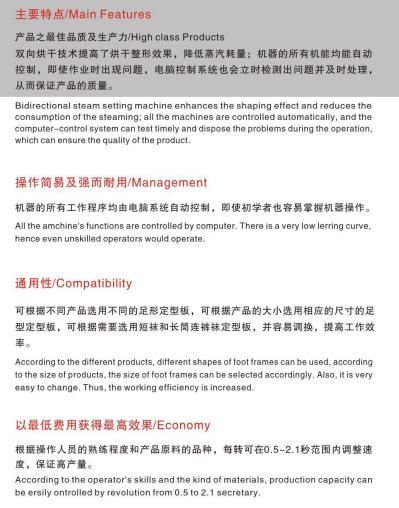
- Control is generally PLC‑based or computer controlled, providing accurate timing of steam injection, drying temperature, conveyor speed and safety interlocks, which helps new operators achieve stable quality with a short learning curve.
- Built‑in alarms and monitoring functions allow quick diagnosis of issues such as abnormal pressure, over‑temperature or conveyor jams, reducing downtime and protecting both the machine and the product.
Socks Pressing Machine: Compatibility, Sizes and Boarding Forms
- SDRS boarding machines are compatible with a wide variety of products including short socks, terry socks, sports socks, school socks, compression styles, stockings and full pantyhose, making them suitable for diversified hosiery factories.
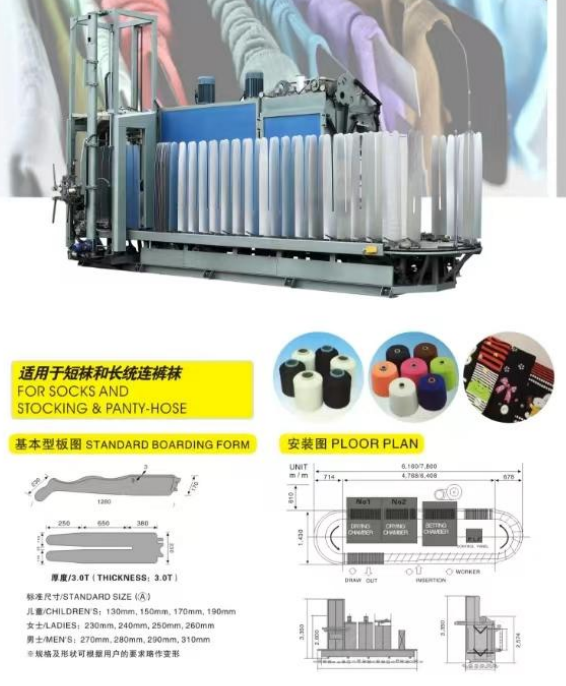
- Standard foot forms are available for children, ladies and men, typically covering lengths from approximately 130–310 mm, and special shapes (such as five‑toe or medical socks) can be custom‑made on request.
- Because the machines are designed with modular frame holders, factories can change the number of frames per block or switch between short and long boarding forms to match different orders, maximising utilisation throughout the year.
- The even heat distribution and controlled tension on the boards help improve hand‑feel and visual appearance, so finished socks look fuller, lie perfectly flat in packaging and maintain their shape after repeated washing.
Socks Pressing Machine: Energy Efficiency, Durability and Layout
- Modern rotary steam boarding equipment is engineered to minimise steam and air consumption, using well‑insulated chambers and efficient circulation fans so more heat goes into the product and less is lost to the environment.
- Heavy‑duty frames, reinforced chains and industrial‑grade bearings ensure long service life even under continuous 24‑hour operation, reducing maintenance costs and unplanned stoppages for high‑volume producers.
- Compact floor‑plan layouts supplied with the machines help users plan boiler placement, operator positions and material flow so loading, setting and packing form a smooth, ergonomic production cell.
- Overall, SDRS steam and electrical sock boarding machines give hosiery manufacturers a reliable, scalable and energy‑efficient solution for converting freshly knitted socks into premium finished products that are ready for branding, packing and export.